For individual investors and finance professionals who need a defensible, board-room ready valuation—without paying $5,000–$50,000 for a single engagement.
I started asking that question after watching thousands of people lose money—not because they picked the wrong company, but because they had no framework for knowing what it was actually worth.
The problem was never knowledge. The gap was always tooling—a model built to the standard that actually holds up, with every input sourced, every assumption documented, and every output explainable under pressure. Too many investment decisions are presented with confidence, then challenged on the most basic question: where did this number come from?
Build a full discounted cash flow forecast over ten years with free cash flow projections, terminal value calculation, and a clean output waterfall.
Complete cost of equity (CAPM-based with beta, risk-free rate, equity risk premium) and cost of debt inputs with automatic weighting to deliver a precise discount rate.
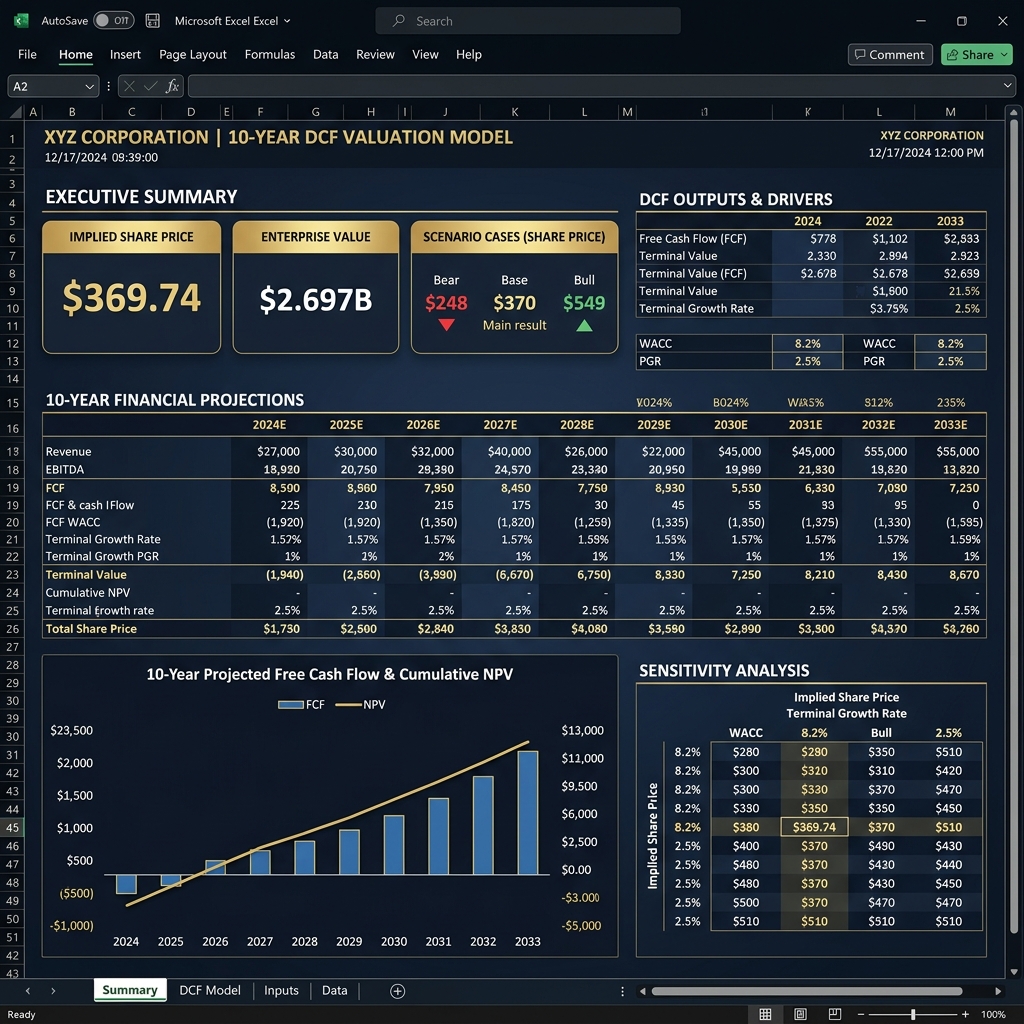
Bear, Base, and Bull cases with fully linked outputs—$248, $370, and $549 implied share price on the pre-loaded Microsoft example.
See how share price moves as terminal growth rate and WACC change across a two-dimensional grid—no manual calculation required.
At base case: Enterprise Value of $2,697B and Implied Share Price of $369.74—every intermediate step visible and auditable.
Prompt-based prompts that generate a CFO-grade narrative around your model outputs—use them in board decks, investment memos, or client presentations.
A board-ready valuation summary template that frames every assumption, scenario, and output in the language of institutional investment committees.
Every assumption is documented and sourced—no orphan numbers. A full audit trail so you can defend every input under scrutiny.
Automatic flagging when outputs move beyond materiality thresholds with explainable gap analysis that shows exactly what drove the change.
Evaluate competitive advantage duration by comparing return on invested capital against the cost of capital over the full projection period.
Microsoft is the pre-loaded worked example. Replace the inputs—every output recalculates automatically.
These are Microsoft outputs from the pre-loaded example. Every number is sourced and documented inside the model.
Replace the inputs once. Value any publicly listed company with the same institutional framework.
A single valuation engagement: $5,000–$50,000. This model: $97.
Instant delivery via Gumroad. Excel file — no macros required.
Microsoft is pre-loaded as a worked example so you can see how every input flows through to the outputs. You can replace every assumption with data for any publicly listed company—the model recalculates automatically. There are no hard-coded values tied to Microsoft.
You should be comfortable navigating Excel and understanding basic financial concepts like free cash flow, discount rates, and growth rates. The model is structured with clear input cells and documented assumptions, but it is not a one-click tool. If you can populate green input cells and read the output dashboard, you can use this model effectively.
The model is designed for anyone who takes investing seriously. You do not need a finance degree to use it, but you should be willing to learn how DCF works. Every assumption has a description and source suggestion, and the AI Commentary layer can help you understand what the outputs mean. If you are new to valuation, treat this as both a tool and a learning framework.
Free templates typically contain orphan numbers, undocumented assumptions, and no governance layer. This model includes a WACC Builder with explained inputs, a sensitivity table, three fully linked scenarios, threshold flagging, ROIC spread analysis, and an AI Commentary layer that generates a CFO-grade narrative. Every input is sourced. Every output is explainable. The difference is the standard to which the model is built—the same standard used in $5,000–$50,000 valuation engagements.